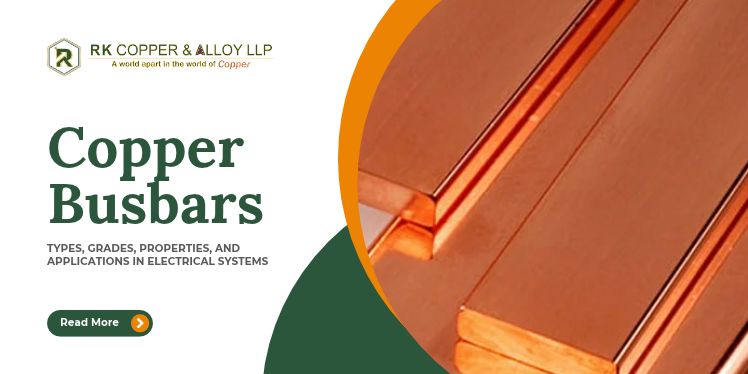
Copper Busbars carry and distribute heavy current inside switchgear, panels, and substations using solid rectangular conductors instead of bundled cable runs. Electrical designers choose copper because it conducts at 100% IACS in ETP temper and moves heat away at roughly 385 W/m·K, which holds temperature rise down at sustained load. Copper also forms a thin, adherent oxide that slows further attack in dry indoor enclosures, and half-hard tempers reach 220 to 250 MPa tensile strength, enough to resist electromagnetic forces during a fault. Panel builders, substation contractors, and industrial plants rely on an Electrical Copper Busbar wherever current levels make cable impractical.
What Are Copper Busbars and How Do They Work?
A Copper Busbar works as a common conduction path between an incoming supply, the protective devices, and every outgoing circuit fed from the same board. Current enters at the incoming terminal. From there it travels along the bar’s full cross section to breaker stabs, droppers and outgoing links, so one conductor replaces dozens of individual cable tails and keeps the internal layout predictable. Cross-sectional area governs resistance, and resistance governs the I²R heat the bar must shed. Flat geometry helps here: a 100 x 10 mm bar exposes far more surface per mm² than a round cable of equal area, so it dissipates heat faster through convection and radiation. Cables also carry insulation that traps heat, while bare bars run open inside the enclosure.
Types of Copper Busbars
Four construction formats cover most electrical distribution work, each matched to a different mounting, current and movement requirement.
- Flat Copper Busbars suit electrical panels, switchgear cubicles and power distribution assemblies where straight runs and bolted joints dominate.
- Solid Copper Busbars work where rigid construction, high short-circuit withstand and dependable current conduction matter more than installation flexibility.
- Flexible Copper Busbars connect equipment subject to vibration, thermal movement or tight bend radii inside congested compartments.
- Laminated Copper Busbars serve compact assemblies and power electronics, cutting loop inductance and organising multiple potentials in one stacked package.
Read more on Types of Copper Busbars — Flat, Solid, Flexible, and Laminated Copper Busbars before finalising a panel layout.
Copper Busbar Grades and Material Composition
Two electrolytic grades handle almost all distribution duty. ETP copper, designated C11000 or Cu-ETP under EN 13601, holds 99.90% minimum copper with 0.02% to 0.04% residual oxygen, and that oxygen content poses no problem in air-cooled bolted assemblies. Oxygen-free copper, C10200 or Cu-OF, keeps oxygen below 10 ppm and reaches 101% IACS, which suits brazed joints and hydrogen-rich atmospheres where ETP risks embrittlement. DHP copper, C12200, carries residual phosphorus and trades a little conductivity for better weldability. Purity drives performance directly, since trace iron or phosphorus depresses conductivity sharply. Specify Copper Busbar Grades against ASTM B187, EN 13601 or IS 613 and ask for a mill test certificate. See the full Copper Busbar range for grade-wise availability.
Key Properties of Copper Busbars
Six material characteristics decide how a bar performs across its installed life.
- High electrical conductivity at 100% IACS keeps resistive losses and running energy costs low across continuous load cycles.
- Thermal conductivity near 385 W/m·K spreads hot spots and helps the bar shed I²R heat into surrounding air.
- Mechanical strength of 220 to 250 MPa in half-hard temper resists fault forces while still allowing cold bending.
- Corrosion resistance holds well in dry indoor enclosures, though humid or chemically loaded atmospheres call for plating.
- Electrical resistance rises about 0.39% per °C, so temperature rise and current rating stay linked.
- Surface condition, bolt torque and joint resistance influence hot-spot formation more than bar material alone does.
Study the Composition & Electrical Properties of Copper Busbars when comparing grades for a specific duty.
Copper Busbar Sizes, Dimensions, and Current Ratings
Copper Busbar Sizes follow four parameters: width, thickness, length and the resulting cross-sectional area in mm². Indian panel work commonly uses 3 mm to 20 mm thickness against widths from 12 mm to 200 mm, cut to run length. As thickness and resistance fall, a thick narrow bar dissipates heat worse than a thin wide one of identical area, because the surface-to-volume ratio drops. Ambient temperature, enclosure ventilation, bar orientation, phase spacing and the number of bars per phase all shift the final rating. Treat published current tables as a starting point only. Verify every rating against IEC 61439 temperature-rise limits, manufacturer data, and a thermal calculation for the actual assembly.
Copper Busbar vs Commercial Copper Flats
Commercial copper flats arrive as general-purpose stock with looser dimensional tolerance, unguaranteed conductivity and rougher mill edges. A busbar-grade product carries a certified conductivity figure, tighter thickness tolerance, deburred edges, and a clean contact surface ready for bolting. Compare both Copper Busbar vs Commercial Copper Flats before buying on price alone.
Copper Busbar Manufacturing Process
Production starts with grade verification and visual inspection of the incoming copper. Operators then cut bars to length, bend or form profiles on press brakes, and punch or drill connection holes to the approved drawing. Deburring and edge finishing follow, then surface cleaning, dimensional verification and electrical inspection. Tin, silver or nickel plating applies where the service environment demands it. Dimensional accuracy, crack-free bends, flat contact faces and documented compliance with project specifications decide whether the bar performs once energised.
Applications of Copper Busbars in Electrical Systems
Copper Busbar Applications span almost every point where current concentrates in a modern electrical installation.
- Switchgear and circuit breaker assemblies, where bars link incomers, bus sections and outgoing feeders.
- Electrical distribution panels, feeding multiple outgoing ways from one certified common conductor.
- Industrial control panels, carrying motor and drive loads within limited cubicle depth.
- Power distribution units, delivering metered supply to racks and machinery groups.
- Transformers and substations, connecting bushings to switchgear through rigid supported runs.
- Renewable energy installations, collecting solar and wind output at inverter and combiner stages.
- Battery systems and energy storage equipment, joining cells and modules at high DC current.
- Data centres and power electronics, where laminated designs reduce inductance in tight spaces.
Current level, available space, prospective fault current and operating environment reshape the bar design in each case.
How to Select the Right Copper Busbar
Work through eight checks before releasing a purchase specification.
- Continuous current demand and short-circuit withstand rating for the duration specified.
- Copper grade, purity and applicable material standard.
- Width, thickness and total cross-sectional area per phase.
- Installation space, bending allowance and connection arrangement.
- Ambient temperature, enclosure design and cooling method.
- Mechanical supports, insulator spacing and vibration exposure.
- Joint design, surface finish, plating and contact resistance.
- Governing electrical standards and manufacturer recommendations.
Dimensions alone never fix current capacity. Assess the complete assembly, its thermal behaviour and its fault performance together. Know more about copper busbar selection from a technical supplier.
Advantages of Copper Busbars
- High electrical conductivity reduces resistive loss across long continuous runs inside distribution equipment.
- Efficient power distribution replaces multiple cable tails with one organised, inspectable conductor path.
- Compact designs free panel space in switchgear and power electronics assemblies.
- Good thermal conductivity moves heat away from bolted joints and high-current terminations.
- Easy fabrication allows cutting, bending, punching and plating to project drawings.
- Long service life follows correct installation, proper joint torque and scheduled inspection.
Conclusion
Copper busbars hold industrial and commercial power distribution together by moving large currents through compact, serviceable and mechanically stable conductors. Performance depends on matching the right type, grade, cross section and fabrication quality to the actual load, enclosure and fault conditions. RK Copper & Alloy LLP manufactures and supplies electrolytic copper busbars, strips and wires from Mumbai. Contact our technical team for grade-wise specifications, dimensions and application-specific busbar requirements.