What Are Oxygen-Free Copper Flats?
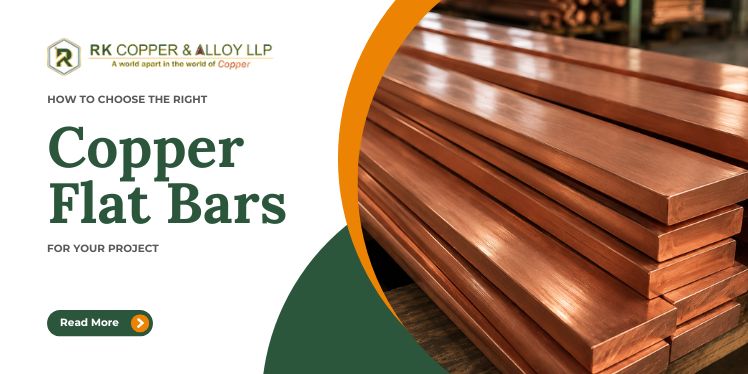
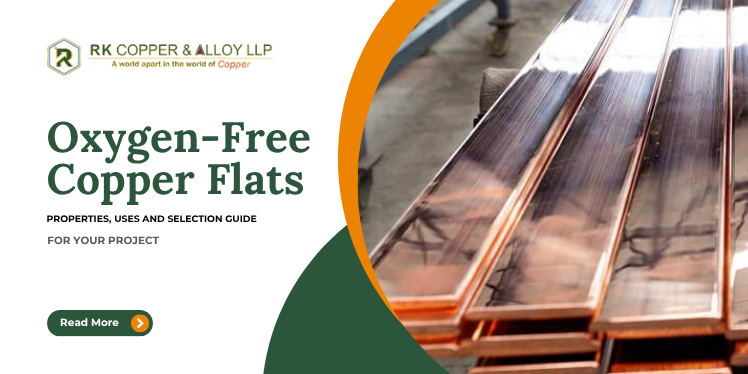
Oxygen-free copper flats are rectangular bar products rolled or extruded from copper refined to strip out nearly all residual oxygen, to below 0.001% by weight. Standard electrolytic tough pitch copper carries oxygen as cuprous oxide particles through the grain structure; oxygen-free copper removes these inclusions during melting under a controlled atmosphere. The flat form puts this high-purity metal into a shape suited to busbars, machined contacts and fabricated conductive parts. Oxygen control matters most in electrical and vacuum work, where trapped oxide can crack under hydrogen exposure or interfere with high-frequency performance. RK Copper & Alloy LLP supplies oxygen-free copper flats in grades matched to these demands.
Key Properties of Oxygen-Free Copper Flats
Oxygen-free copper flat products offer reliable electrical and thermal performance in demanding high vacuum, high heat and hydrogen treatment situations. Subsurface cracking and embrittlement of the joint during intensive heat processing are avoided by the absence of small cuprous oxide inclusions, which maintain integrity.
- Electrical Conductivity: Conductivity up to 101% IACS is preserved along grain boundaries, not impeded by oxide particles.
- Thermal Conductivity: Ensures consistent flow of heat at ~390–400 W/m·K for dual electrical and thermal loads.
- Ultrahigh Purity: Minimum copper content of 99.95% to 99.99%, depending on grade needed.
- Excellent Ductility: Maintains high cold forming capabilities and minimizes cracking issues in forceful bending and rolling.
- Joining Performance: Clean enables brazing and soldering without voids caused by oxides when heated.
- Hydrogen Embrittlement Resistance: Resists hydrogen exposure, leading to the formation of steam pockets at high temperatures and during vacuum firing.
Oxygen-Free Copper Grades
Two grades cover most oxygen-free flat requirements. C10100, oxygen-free electronic copper, carries a minimum 99.99% copper content with oxygen held below 0.0005%. It suits work demanding the tightest purity control, such as vacuum electron devices and precision electronic components. C10200, oxygen-free copper, sets a lower bar at 99.95% minimum copper with oxygen below 0.001%, covering general oxygen-free industrial use at a more accessible cost. The choice between them rests on required purity, conductivity tolerance, and the application’s sensitivity to trace impurities.
Applications of Oxygen-Free Copper Flats
Heavy-duty industries require oxygen-free copper flats. They keep gadgets cool, power flowing smoothly and high-tech vacuums squeaky-clean.
- Power distribution: Handles high electrical currents through busbars, transformers and switchgear, while optimizing surface cooling.
- Semiconductor manufacturing: Stable vacuum chamber components and target backing plates with no outgassing.
- Vacuum electronics: Ultra-clean vacuum feedthroughs and waveguide sections that you can trust.
- Thermal management: high-efficiency cold plates and heat exchangers with enhanced heat conductivity.
- Electrical fabrication: Machinable to heavy-duty electrical terminals, contacts and connector bodies.
- High-temp brazing: Resists hydrogen embrittlement in delicate instruments housings and industrial furnace parts.
How to Select Oxygen-Free Copper Flats
Start with grade: choose C10100 for maximum purity, C10200 for general oxygen-free service. Width and thickness follow from the current-carrying or structural requirement. State the required conductivity as a minimum % IACS figure rather than leaving it general, since this drives grade selection and mill testing. Temper matters as much as grade. Soft-annealed material forms and bends more easily; half-hard or hard tempers suit applications needing dimensional stability under load. Flag machining and fabrication needs, including drilling, notching and edge finishing, before ordering to avoid rework. Operating temperature affects grain stability, particularly under repeated thermal cycling near the recrystallisation point. Confirm the applicable specification, surface finish, and testing or certification requirements, including mill test certificates for oxygen content and conductivity, before placing an order.
Oxygen-Free Copper Flats vs Conventional Copper Flats
| Factor | Oxygen-Free Copper Flats | Conventional Copper Flats |
| Oxygen level | Below 0.001% | Depends on grade, up to 0.04% in tough pitch |
| Purity | 99.95% to 99.99% | Grade dependent, around 99.90% minimum |
| Conductivity | High, consistent across the section | Grade dependent |
| Hydrogen embrittlement resistance | Strong advantage in reducing atmospheres | Depends on copper type |
| Typical use | Vacuum, semiconductor and hydrogen-brazed work | General electrical and fabrication work |
Neither type outperforms the other across every job. Conventional tough pitch flats remain a sound, cost-effective choice for standard busbar sections and general fabrication where hydrogen exposure and vacuum service play no part. Oxygen-free flats justify their added cost specifically where oxide-related failure modes present a real risk: hydrogen furnace brazing, vacuum firing, or semiconductor process equipment. Picking oxygen-free copper as a blanket upgrade, without one of these conditions present, adds cost without a matching technical return. The application’s exposure to hydrogen and vacuum, not habit, should decide the choice.
Conclusion
Choosing between oxygen-free and conventional copper flats depends on the operating environment, not on a default preference for higher purity. Match grade, temper and dimensions to conductivity needs, fabrication method and exposure to hydrogen or vacuum conditions. Confirm certification requirements before ordering, and select flats sized to the actual current and structural load rather than the nearest standard stock size.