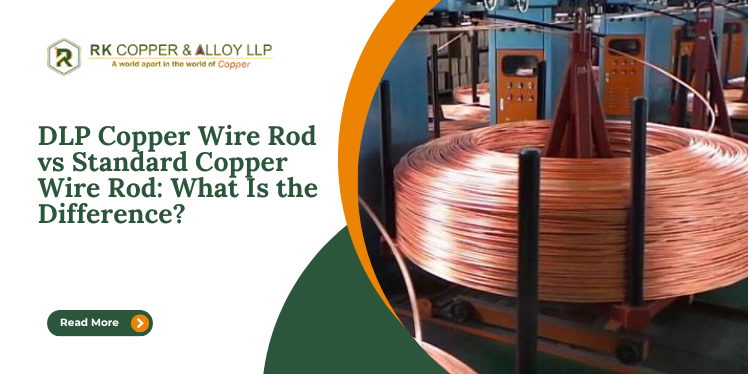
Copper buyers often treat wire rod as one product with different diameters, but it is not. A rod chosen for welding electrodes will not behave the same way in a high-conductivity power cable, and mixing up grades leads to failed joints or wasted material. DLP Copper Wire Rod is a specific, defined copper type. Standard copper wire rod is a broad commercial label covering several grades. Neither is universally better; the right choice depends on the application for which it will be used.
What Is DLP Copper Wire Rod?
DLP copper rod stands for Deoxidized Low Phosphorus copper, identified under UNS C12000. Manufacturers deoxidize this copper with a controlled, low addition of phosphorus, just enough to remove oxygen without leaving excess phosphorus behind that would drag down conductivity. This balance gives DLP copper wire rod good forming, welding and joining characteristics, which is why fabricators favor it for parts that get bent, brazed or welded during processing. DLP Continuous Cast Copper Wire Rod is supplied for exactly this purpose, produced through a continuous casting process that keeps the copper’s structure and residual phosphorus content within a tight, repeatable range. Buyers working on welded assemblies or formed components typically look at this grade first.
What Is a Standard Copper Wire Rod?
A copper wire rod sold as standard could be Electrolytic Tough Pitch (ETP) copper, oxygen-free copper, or another type, and ASTM B49 covers several of these as separate specifications rather than a single product. Each grade carries its own oxygen content, deoxidation method and mechanical profile. Two rods both labeled standard can perform very differently once you check conductivity, ductility or resistance to hydrogen embrittlement. The specification sheet determines what the rod will actually do in service.
DLP Copper Wire Rod vs Standard Copper Wire Rod
Here is how the two compare on the factors that matter for procurement and fabrication:
| Factor | DLP Copper Wire Rod | Standard Copper Wire Rod |
| Copper type | Deoxidized low-phosphorus copper | Depends on grade |
| Typical designation | C12000 | Grade/specification dependent |
| Deoxidation | Phosphorus-deoxidized | Depends on copper type |
| Conductivity | Good, grade dependent | Depends on grade |
| Weldability | Very good | Depends on grade |
| Formability | Good | Depends on grade |
| Selection | Welding/fabrication + conductivity requirements | Electrical/conductor requirements based on grade |
Key Differences in Performance
The core difference sits in composition and deoxidation method. DLP Copper Wire Rod carries a controlled phosphorus residue that ties up oxygen during melting, while other grades under ASTM B49, such as ETP or oxygen-free copper, manage oxygen through different processes entirely. That single variable, phosphorus content, shapes everything downstream. Electrical conductivity shifts with it. Weldability improves with it, since phosphorus-deoxidized copper resists the porosity and cracking that can occur when welding higher-oxygen grades. Formability follows a similar pattern, tracking grain structure and oxide content rather than one fixed number across all copper types.
Applications and Selection
- DLP copper wire rod suits welded fittings, brazed assemblies and components needing reliable fusion joints.
- Fabricators forming tubes, wire and profiles often select DLP for its consistent bending behavior during continuous cast copper wire rod processing.
- High-conductivity electrical conductors and busbars may call for ETP or oxygen-free grades instead, where minimizing resistance is the priority.
- Projects involving hydrogen-atmosphere brazing or annealing often specify oxygen-free copper to avoid embrittlement risk.
- Mixed fabrication runs, cutting, forming and welding in one line, frequently standardize on deoxidized low phosphorus copper to simplify processing.
Conclusion
DLP Copper Wire Rod and standard copper wire rod are not competing for the same job; they handle different requirements. Choosing between them means checking the grade, the governing specification, the conductivity target, the fabrication method and the final application together, not picking one label over the other by default. RK Copper & Alloy LLP supplies both DLP and standard copper wire rod grades to match these varying project needs.