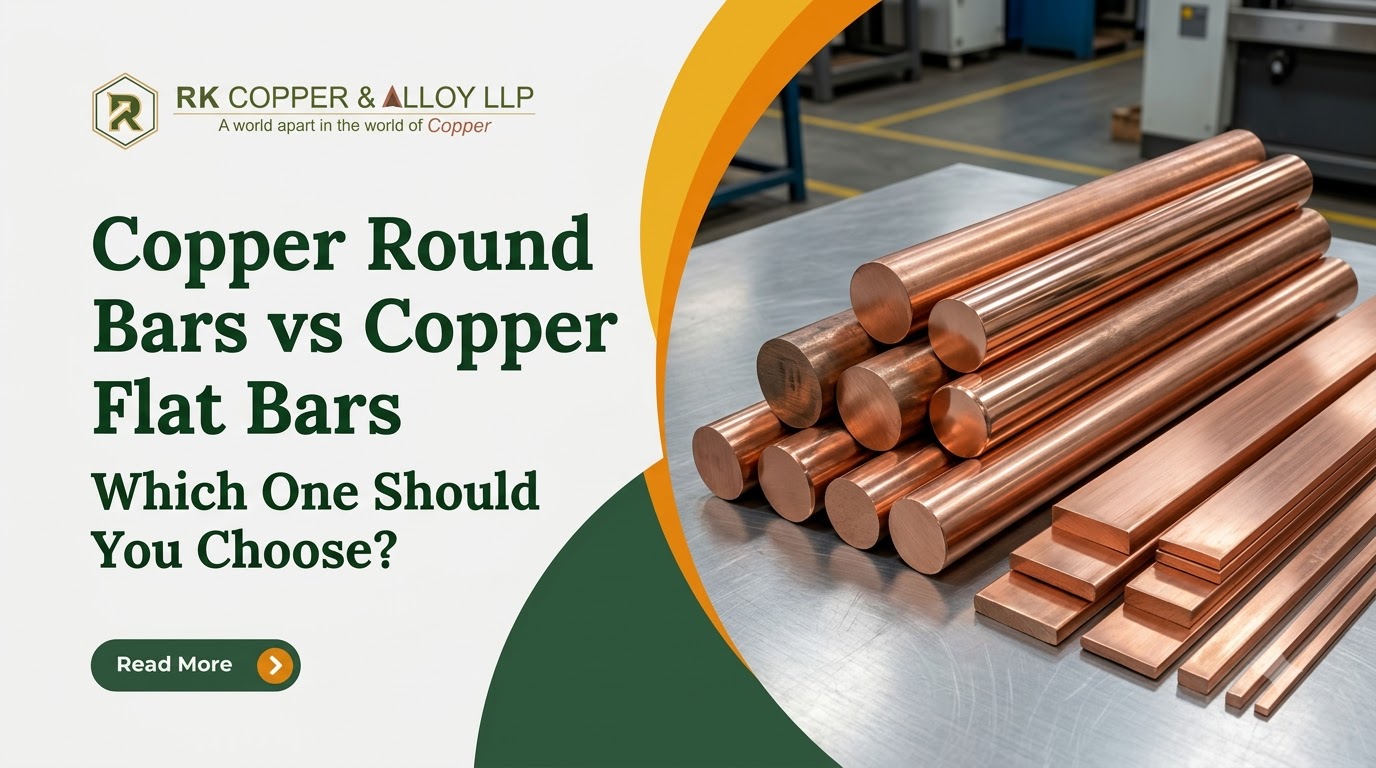
Two bar profiles continue to appear in the same order: round bars and flat bars. Both start from the same electrolytic copper. Both carry current and heat with almost no resistance loss. Copper Round Bars turn, drill, and thread cleanly on rotating equipment. Copper Flat Bars are centred against busbar mounts and grounding straps without any modification. This guide breaks down where each profile earns its place on the shop floor.
Understanding Copper Round Bars and Copper Flat Bars
Copper Round Bars are produced by the mill as solid cylinders, drawn or extruded to a fixed diameter, from 4 mm to 70 mm, in lengths up to 6 metres, and manufactured to ASTM B133, ASTM B124, and ASTM B187. Shafts, bushings, terminals, and machined connectors pass through round stock because a lathe removes material evenly around a circle.
Copper Flat Bars run rectangular, 1 mm to 60 mm thick and 5 mm to 350 mm wide, in lengths up to 6.4 meters, built to ASTM B187 Copper Bars standards. It connects directly onto switchgear panels, stacks inside busbar chambers, and bonds to grounding grids without any turning operation. Fabricators trim, punch, and bend flats.
Copper Round Bars vs Copper Flat Bars: Quick Comparison
|
Property |
Copper Round Bars |
Copper Flat Bars |
| Shape | Cylindrical | Rectangular |
| Machining | Turns smooth on a lathe | Cuts, punches, and bends without turning |
| Electrical use | Connectors, terminals, pins | Busbars, grounding grids, switchgear |
| Structural use | Shafts, bushings, machined parts | Brackets, panel supports, mounting straps |
| Sizing basis | Diameter, 4 mm to 70 mm | Width and thickness: 5 mm to 350 mm x 1 mm to 60 mm |
| Governing standard | ASTM B133, B124, B187 | ASTM B187 |
When Should You Choose Copper Round Bars?
Choose round stock when the part spins, threads, or needs a machined finish a flat profile cannot deliver.
- CNC or manual turning jobs that need a true centreline
- Rotating components such as bushings and sleeve bearings
- Precision connectors and terminal pins with tight diameter tolerance
- Fasteners and studs cut directly from bar stock
- Machined shafts and pins for industrial machinery
Round bars hold conductivity above 97% IACS in half hard temper and above 99.95% IACS annealed. Grades range from C10100 through C11000, so purity can be matched to the precise load a part sees. Research the full Copper Round Bars range, or check Oxygen-Free Copper Round Bars for minimal oxide content and maximum conductivity.
When Should You Choose Copper Flat Bars?
Choose flat stock the moment the task requires moving power across a panel.
- Busbar systems distributing current inside switchgear and panel boards
- Earthing and grounding straps bonded to structural steel
- Power distribution links between transformers and switchboards
- Telecommunications grounding grids and equipment racks
- Structural brackets and supports that need a flat mounting face
Copper Flat Bars bolt straight onto a busbar chamber, which keeps installation time down on panel builds. A flat face also lets two or more conductors stack and clamp together. In power distribution and telecom grounding, especially where dozens of connection points are located within one panel.
Factors to Consider Before Making Your Choice
Application Requirements
Machined and rotating parts point to round stock. Current distribution and grounding indicate a flat surface.
Mechanical Design
Check available installation space before finalizing a size. A flat bar needs clearance along its wide face. A round bar needs a bore, clamp, or chuck that matches its diameter exactly.
Electrical Performance
Current density and terminal count determine the working cross section needed to perform a task. Higher busbar loads move to a wider or thicker flat rather than to a larger round bar, since flats offer more surface area for bolted or clamped connections.
Machining and Fabrication
Round stock removes less material when the final part is cylindrical. Flat stock skips machining and goes straight to cut length. Pick whichever profile removes machining hours from the build schedule.
Why Material Quality and Standards Matter
ASTM B187 Copper Bars specifications cover round and flat copper bars for electrical service, and each unit should carry mechanical, chemical, hardness, and intergranular corrosion test results before it ships. Choose a Copper Round Bar Supplier that provides a mill test certificate to EN 10204/3.1B, plus radiography and third party inspection reports on request. A supplier stocking both profiles across matching grades, from C10100 through C19400, reduces the number of vendors procurement has to manage on one project.
Conclusion
Copper Round Bars are suitable for applications that need a lathe, a tight tolerance, or a rotating part. Copper Flat Bars are ideal for applications that require current distribution, grounding, or a bolted panel connection. Contact RK Copper & Alloy LLP to confirm sizing, grade, and standard compliance for your next Copper Round Bar or Copper Flat Bar order.