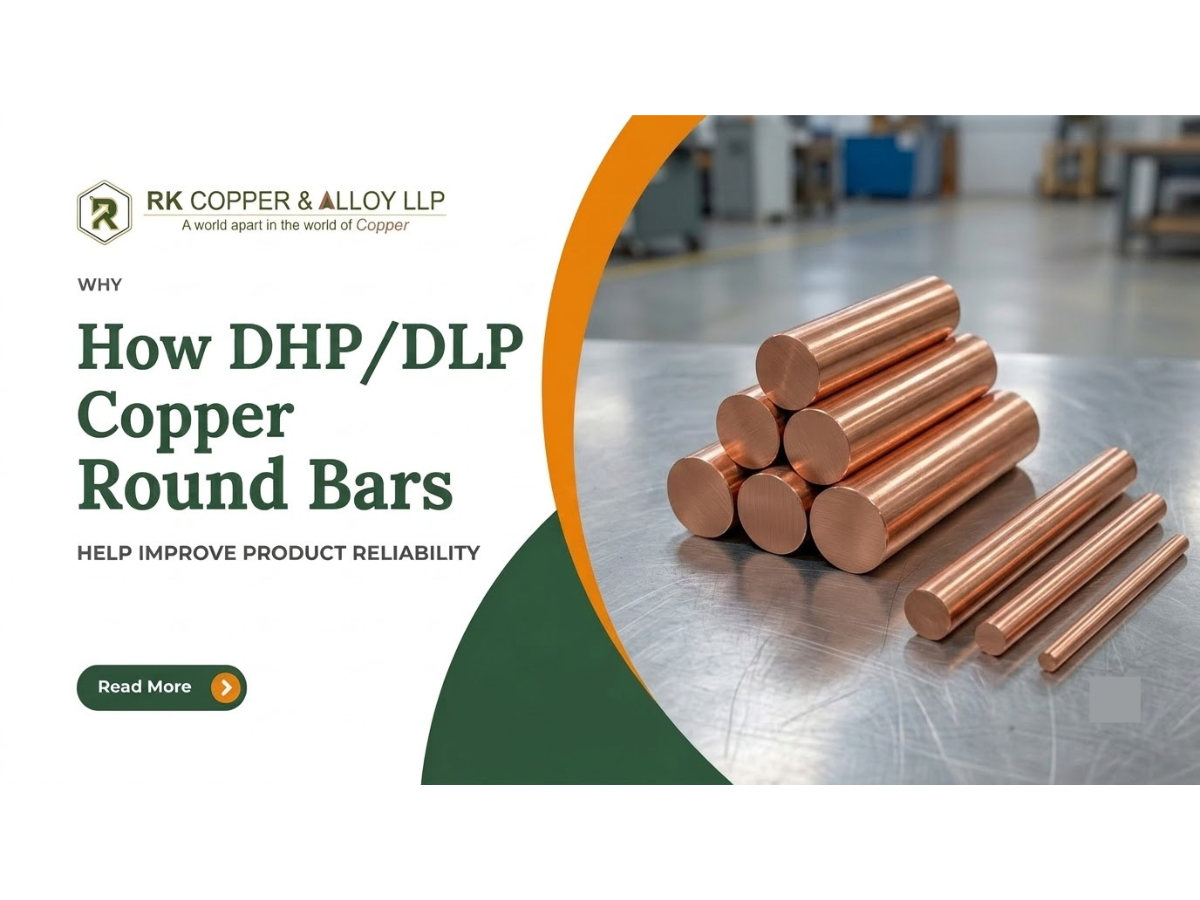
DHP/DLP copper round bars improve product reliability by ensuring stable performance throughout a component’s working life. DHP (Deoxidized High Phosphorus) and DLP (Deoxidized Low Phosphorus) copper round bars are manufactured for this exact reason: dependable performance, durability, and predictable fabrication behavior. Picking the right grade cuts maintenance frequency and extends service life once the part is in service.
What Are DHP/DLP Copper Round Bars?
DHP copper carries a residual phosphorus content of roughly 0.015 to 0.040%. DLP copper runs lower, typically 0.004 to 0.012%. That gap changes welding and electrical performance, though both retain strong corrosion resistance and good workability. C12200 covers DHP commercially, C12000 covers DLP, and both are supplied to ASTM B187 for round bar production. DHP/DLP Copper Round Bars ship in a range of diameters and cut lengths, keeping the material practical from small precision parts to larger structural components.
Why Material Selection Affects Product Reliability
Selecting an incorrect copper grade during the design phase can lead to downstream operational issues, typically manifesting as inconsistent component performance or unscheduled maintenance. The right grade holds its composition steady across production batches, so one part behaves the same as the next. Additionally, the fabrication process runs cleaner, resulting in fewer defects, less scrap material, and a reduction in reworked parts. Durability in the base material shows up as fewer maintenance calls once equipment is functioning, which matters most in electrical infrastructure and industrial machinery.
How DHP/DLP Copper Round Bars Improve Product Reliability
The practical advantages of DHP and DLP copper round bars stem directly from four core material characteristics that drive consistent performance in demanding environments.
Excellent Corrosion Resistance
Both grades hold up well in industrial and plumbing environments where moisture and process fluids come in contact with the surface daily. Oxidation stays minimal, which is why components stay in service years past their expected replacement date.
Good Fabrication and Weldability
DLP copper welds cleanly, largely because its lower phosphorus content limits porosity in the weld zone. DHP copper machines and forms just as predictably, though its higher phosphorus level suits it less to certain welding processes.
Consistent Mechanical Performance
Bar stock with tight compositional control behaves the same way under load, batch after batch. Manufacturers building to a fixed tolerance depend on that consistency; one off-spec batch can force an inspection hold on a finished run.
Long Service Life
Copper’s inherent durability pushes replacement intervals out further than many alternative materials manage. Fewer swap-outs mean lower total cost of ownership, particularly where downtime adds to the overall cost.
Industries That Benefit from DHP/DLP Copper Round Bars
A handful of industries lean on DHP/DLP copper specifically because a failed component there means more than a warranty claim.
Heat Exchangers
Thermal conductivity paired with corrosion resistance keeps heat transfer steady through thousands of thermal cycles, a demand few other materials handle as well.
Plumbing Systems
Constant water contact is the normal operating condition here, not the exception, and corrosion resistance keeps fittings and pipework functional for decades.
Electrical Fittings
Wiring connections built from DHP/DLP copper hold conductivity steady over time. In commercial installations, a degrading connection is a fire risk, not just a maintenance item.
Connectors and Terminals
Tight machining tolerances matter most here. Consistent bar stock gives manufacturers a predictable starting point, cutting fit-up problems that come from raw material varying batch to batch.
Automotive Components
Vibration, heat cycling, and years of road exposure test a component’s material choice more than most applications. Corrosion-resistant copper handles that combination without early failure.
Telecommunications Equipment
Signal quality depends on stable electrical properties at every connection point. Components machined from DHP/DLP copper hold that stability as installations age.
Industrial Machinery
Continuous mechanical load wears down weaker materials fast. Copper’s fabrication consistency keeps replacement parts interchangeable, shortening downtime when a swap is finally needed.
What to Look for When Purchasing DHP/DLP Copper Round Bars
A handful of checks before ordering can save a project from a costly mismatch.
- Confirm the supplied bars meet ASTM B187 or another applicable industry specification.
- Verify the exact grade, C12000 or C12200, matches what the design calls for.
- Request a valid Mill Test Certificate as proof of material certification.
- Check that dimensions and tolerances match the project drawing precisely.
- Confirm stock availability covers the full quantity the project requires.
- Ask what quality inspection steps happen before the material ships.
Why Buying from a Trusted Supplier Matters
Sourcing from an established supplier of DHP/DLP Copper Bars & Flats protects reliability at a point the material spec alone can’t cover. Batch-to-batch variance is reduced by certified stock and consistent quality by order. Having multiple sizes and both grades on hand makes it easier to get the product you want and ensures you have the product on time, as a shortage can cause your schedule to slip. Technical support is available when ordering to ensure they are buying the correct grade.
Conclusion
Corrosion resistance, easy-clean fabrication and consistent mechanical performance make DHP/DLP Copper Round Bars a reliable choice for long-lasting components. When manufacturers match the right grade with a supplier that can back it up with certification and consistent stock, they have a real chance of achieving longer service life and fewer field failures. Contact RK Copper & Alloy LLP for help selecting the right copper round bars for your application.