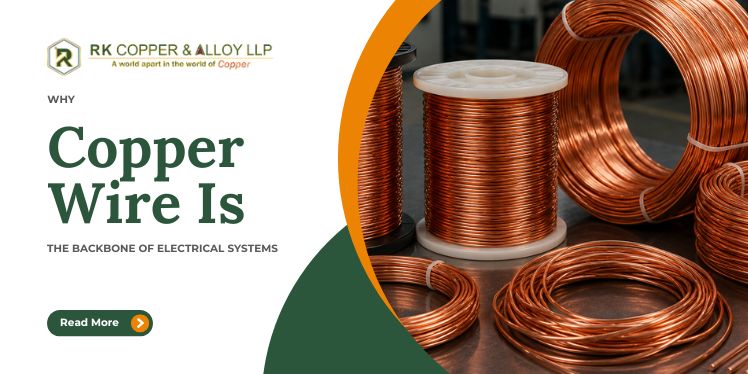
Every electrical system depends on the quality of its conductors. A power grid is only as strong as the material carrying current from point to point, and a weak link anywhere means energy loss or failure. Homes, factories, transportation networks, and hospitals all run on electricity delivered through a medium that has to perform under load, year after year, without degrading.
Copper Wire has carried that responsibility for more than a century, and Copper Wire bars remain the starting point for nearly every conductor used in transmission and distribution today. Copper conducts electricity efficiently, resists corrosion, and bends without cracking: three traits few materials combine at the same price point. Construction, manufacturing, renewable energy, automotive, and power generation companies all depend on it for the same reason: it works, consistently, under demanding conditions.
What Is Copper Wire?
Copper Wire is a drawn copper conductor used to carry current and signals between two points in a circuit. Manufacturers melt high-purity copper cathode, cast it into rod form, then pull it through progressively smaller dies to the required gauge. The finished wire typically contains 99.9% pure copper, giving conductivity close to the theoretical maximum for a commercially viable metal. Aluminum costs less per pound but carries roughly 61% of copper’s conductivity at the same cross-section, requiring a larger gauge to match performance. Gauges from fine signal wire to heavy industrial cable in solid, stranded, bare and insulated.
Why Copper Is the Preferred Material for Electrical Systems
Copper has been the industry standard for decades because its properties match what electrical systems require.
- 100% IACS electrical conductivity, standard for conductors
- Good thermal conductivity, quick heat dissipation
- Excellent ductility, flexibility and can be drawn into fine wire without loss of strength
- Corrosion resistance, forms a protective oxide layer on the surface
- Good mechanical strength, resistant to bend and vibration
- Easy installation, flexibility and solderability make termination faster
- Long service life, outlives the buildings it serves
Why Copper Wire Is the Backbone of Modern Electrical Systems
Copper Wire is a critical component of electrical infrastructure, carrying current from generation to end use with little loss. Power plants, Substations and Distribution panels need Copper Wire bars and Copper conductors to carry load without the voltage drop lower-cost materials cause over long runs. Less energy is lost and more power is available for use per unit generated. Conductors that run cooler are less likely to cause insulation to degrade or thermal faults to occur. Over a system’s life, this shows up as lower maintenance costs, fewer outages, and equipment holding its rated performance for decades.
Key Benefits of Using Copper Wire
The conductor chosen for a project affects more than installation cost; it shapes performance for life.
- High energy efficiency, more delivered power per watt
- Lower power losses, reduced resistance across transmission runs
- Better heat dissipation, connection points stay cooler
- Improved electrical safety, stable terminations lower fault risk
- Excellent durability, resists fatigue from cycling and stress
- Reduced maintenance, fewer terminations corrode or loosen
- Long operational lifespan, installations commonly exceed 50 years
These advantages pay back the investment through reduced lifecycle costs.
Common Applications of Copper Wire
Almost every industry that uses electricity is dependent on Copper Wire.
Residential Electrical Wiring standard for branch circuits and panel feeds .
Commercial Buildings supports HVAC, lighting and IT loads.
Industrial manufacturing plants have a high current from machinery.
Power Generation Facilities, reduces the transmission loss at scale.
Electric Vehicles, compact wiring for high current.
Telecommunications Infrastructure, maintains signal integrity and grounding.
Why Choose RK Copper & Alloy LLP for Copper Fittings & Connectors?
RK Copper & Alloy LLP Manufacturer of Copper Strips, Copper Wires & Fabricated Copper Products. Its portfolio of copper fittings and connectors is based on decades of production experience and is designed for applications where the quality of the connection is key to the system’s performance. Every product begins with carefully selected electrolytic copper, manufactured to exacting dimensional and purity specifications.
The product range includes multiple sizes and specifications and customized solutions for non-standard projects. Quality control at each step ensures consistent output batch to batch. This is important when fittings have to be identical throughout a large installation. The company serves the electrical, renewable energy, infrastructure, manufacturing, and power generation sectors.
Backing up each order with timely delivery and technical support helps project teams find the right specification. This consistency in quality has developed the company’s image among repeat clients across the Indian market.
Factors to Consider Before Selecting Copper Wire
Selecting the correct Copper Wire is not just a sizing exercise; it affects safety and long-term performance.
- Current carrying capacity: match ampacity to actual and peak load
- Wire gauge and thickness: undersized gauge increases resistance and heat
- Voltage requirements: confirm insulation rating matches system voltage
- Operating temperature: account for ambient and load-generated heat
- Installation environment: indoor, outdoor, and chemical exposure need different protection
- Industry standards and certifications: verify compliance with applicable specifications
- Budget and lifecycle costs: weigh upfront price against energy loss over time
Conclusion
Copper Wire is a key component of Electrical Systems, as it is one of the few materials that can match it in terms of conductivity, durability, safety and efficiency. Copper conducts current with minimal loss and lasts for decades in construction, manufacturing, renewable energy, automotive, and telecommunications. From Copper Wire bars feeding rod mills to finished conductors in homes, factories and power grids.
RK Copper & Alloy LLP brings close to three decades of manufacturing experience to that supply chain, producing copper fittings and connectors built for modern electrical infrastructure. Talk to the team about the right copper specification for your next project.