Power demand across the industry keeps rising, and panel wiring has to keep pace. Data centers run continuously, solar plants feed the grid around the clock, and manufacturing units pull heavy loads through equipment never built for this scale. None of that works without conductors rated to carry large currents safely, which is the gap Copper Bus Bars fill.
Copper BusBars connect incoming power to outgoing circuits in panels and switchgear, reducing resistance losses in the process. They enhance reliability and energy efficiency for power generation, renewable energy, manufacturing, and transportation.
What Are Copper Bus Bars?
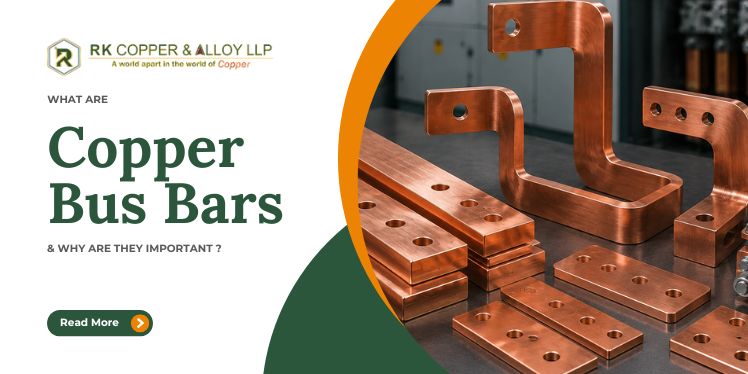
A copper bus bar is a solid strip, rod, or bar of copper used to carry and split electrical current inside a panel or distribution unit. It connects incoming supply to multiple outgoing circuits through one low-resistance path. Copper gets the job over other metals for one reason: its conductivity is second only to silver. Bus bars come flat, rectangular, or tubular depending on current rating, and switchboards, transformers, and control panels across Indian industry rely on this format.
How Do Copper Bus Bars Work?
One bar takes incoming current and routes it to several circuits at once, replacing dozens of individual wire runs with a single connection. Panel layouts shrink, connection points drop, and maintenance gets simpler.
Copper has a resistivity of about 1.68 microohm-cm at room temperature, so it will not produce a large voltage drop when carrying a heavy current. Less resistance means less heat, so panels remain cooler and continue to perform steadily under sustained loads.
Why Copper Is the Preferred Material for Bus Bars
Few metals match copper across the properties that current-carrying applications demand.
- Excellent electrical conductivity
- Superior thermal conductivity
- High mechanical strength
- Corrosion resistance
- Excellent durability
- Easy fabrication
- Long service life
Together, these properties cut energy loss and extend equipment life.
Why Copper Bus Bars Are Important in Modern Electrical Systems
We need distribution systems that can handle higher current density without adding to the bulk. That load is handled by Copper Bus Bars in a compact footprint replacing thick cable bundles. Copper BusBars also limit I²R losses, keeping operating temperatures lower and panels safer.
Benefits of Using Copper Bus Bars
A properly fabricated, correctly rated bus bar changes how the whole system performs over time.
- Higher electrical efficiency
- Lower power losses
- Better heat dissipation
- Reduced installation complexity
- Improved operational safety
- Long service life
- Lower maintenance requirements
Fewer failures and less wasted energy bring operating costs down year over year.
Common Applications of Copper Bus Bars
Seven applications account for most of this demand.
- Electrical control panels need conductors that fit tight enclosures at full load current.
- Switchgear systems put bars through repeated switching cycles, which copper’s strength tolerates.
- The power distribution units distribute the incoming supply to the circuits with the minimum voltage drop.
- Inverters operate solar power systems with variable loads. Copper resists outdoor corrosion.
- Data centers pull continuous, dense current, so rack-level overheating is limited.
- The EV charging infrastructure delivers high current in short bursts and there is no excess heat at the terminals.
- Manufacturing facilities see fluctuating motor loads, which copper bus bars keep stable.
Why Choose RK Copper & Alloy LLP for Copper Fittings & Connectors?
RK Copper & Alloy LLP manufactures and supplies electrolytic copper fittings and connectors for industrial and electrical applications from its facility in Mumbai. The production is organized in the divisionalized model with the focus on constant quality. Available in various sizes, and custom options are available. We offer direct technical support on each order and every batch undergoes rigorous quality control for clients in the electrical, power generation, renewable energy and manufacturing industries.
Factors to Consider Before Selecting Copper Bus Bars
Getting the right bus bar takes more than checking copper purity. Seven factors decide whether it performs reliably under real load:
- Current carrying capacity
- Copper grade
- Dimensions and thickness
- Operating temperature
- Surface finish requirements
- Installation environment
- Industry standards and certifications
Checking each one against the panel’s actual load profile prevents overheating and premature failure down the line.
Conclusion
Copper Bus Bars carry the current behind modern electrical systems, from control panels to EV chargers to solar inverters. Conductivity, strength, and corrosion resistance give Copper BusBars an edge wherever heat, load, and reliability matter together. As power demand grows across manufacturing and renewable energy, properly specified bus bars matter more, not less.
RK Copper & Alloy LLP supplies copper fittings and connectors built for that demand. Consult our team to specify the right solution for your next project.